Hétéronanostructures dissymétriques optimisées à base d'oxydes métalliques avec séparation des porteurs de charge améliorée pour des applications en conversion de l'énergie solaire – OSCARE (CE50)
Coordination: Thierry TOUPANCE ISM/C2M
Duration: 2023-2027
In the context of energy depletion along with global warming and environmental pollution issues, photocatalysis using metal oxide semiconductors (SCs) has attracted worldwide attention. Metal oxide-based heteronanostructures (HNs) that combines two or more electrical, semiconducting, optical, optoelectronic, or catalytic properties in the same system, are very promising photocatalysts. They indeed allow separation of the different functions of the photocatalytic reaction and thus finely tune the properties of each component for one specific aspect (i.e. light absorption, charge transport, and charge transfer). HNs are usually prepared by conventional liquid routes, but these routes do not usually allow accurate control over the spatial distribution of the individual components at the nanoscale, limiting the dissymmetrization of HNs expected to significantly enhance the optoelectronic properties required for photocatalytic applications.
There is therefore a strong need to design new preparation routes for HNs based on nano SCs with an improved charge separation along with: 1) reliable versatility in depositing multi to single nanodots of controlled size, and 2) advanced spectroscopic studies providing fundamental understanding in the interactions between the different types of NPs constituting these new HNs at their junction, to establish new optimized routes for photocatalysis.
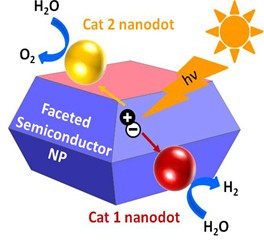
OSCARE develops efficient and dissymmetrical metal oxide HNs based on TiO2 (in UV) and BiVO4 (in the visible) focused on 1) a crystal facet engineering approach of the supporting SC NPs and 2) a laser deposition method: (i) to nucleate and grow true single co-catalyst NDs of controlled size on each SC NP, (ii) to vary their number and distribution for comparisons. The electronic properties of these HNs are then characterized to further test them for H2 (HER) and O2 (OER) evolution reactions as a function of the asymmetric loading.
In summary, the main objectives of the OSCARE project are:
To use and improve the synthesis of facetted TiO2 NPs and develop solution routes for engineering BiVO4 nanoparticles (NPs) by addressing the synthetic issue of particle size reduction from m down to 100 nm and 10 nm with well-defined exposed facets;
To use lasers and their fine-tuning, instead of lamps and LEDs, to efficiently achieve selective deposition of metal and/or metal oxide NDs of controlled size, from multi to true single ND, each on a specific facet of the chosen SC;
To analyze and understand from a fundamental point of view the resulting electronic properties and the expected charge separation improvement when ‘continuously’ varying the dissymmetry up to the ultimate Janus-like HNs
To evaluate and optimize the effect of this varying dissymmetry on the efficiency in H2 and/or O2 production (among all the potential reactions), as the co-catalyst loading (deposited mass, ND size/number) and distribution are expected to play a crucial role.
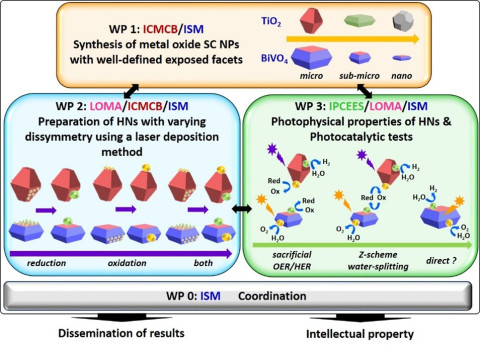
To reach the goals of OSCARE a bottom-up approach will be developed by four complementary reserach teams (ISM/C2M Univ. Bordeaux, ICMCB Univ. Bordeaux, LOMA Univ. Bordeaux and ICPEES Univ. Strasbourg) according to a scientific program based on the three following work packages (WPs).
WP1 includes the preparation and characterization of metal oxide NPs with well-defined exposed facets. Various solvothermal /hydrothermal routes using or not structuring agents are investigated using different activation modes (conventional heating, microwave-assisted).
WP2 concerns the development of a laser-based method for regioselective deposition of reduction and/or oxidation of co-catalysts on facetted SC particlesdeveloped in WP 1 using the new optofluidic route proposed in this project. The steps involve: (i) the demonstration that multi to single-dot laser deposition is indeed truly general and extendable to other metals and metal oxides; (ii) the in-depth investigation of laser co-deposition of two oxidizing/reducing well-separated nanodots on different facets; (iii) the characterization of the properties of the HNs and the quantitative modeling of their growth and dissymmetry; (iv) the upscaling of the HNs production for the in-depth investigation of photocatalytic properties.
WP3 deals with the characterization of the electronic and photocatalytic properties of the HNs by advanced time-resolved spectroscopy methods and the rationalization of their photocatalytic properties in HER and/or OER. HNs are first tested with sacrificial agents that promote H2 and O2 evolution reactions. In particular, a Z-scheme configuration combining TiO2 and BiVO4 based HNs using a reversible redox shuttle will be designed for overall water splitting. If successful, each HN modified by both oxidation and reduction co-catalyst NDs will be tested, alone, without any sacrificial agent or redox shuttle to quantify the impact of nanostructuration and dissymmetrization strategy on the photocatalytic efficiency.