


About
CNRS researcher — Organosilane, oligomeric silsesquioxane and silica-based material synthesis
Institut des Sciences Moléculaires (ISM) — UMR 5255 CNRS / Université de Bordeaux


Since 2025: CNRS Researcher at the Institute of Molecular Sciences of Bordeaux (France).
2023-2024: Post-doctoral fellowship awarded by the Alexander von Humboldt fellowship and hosted by Prof. Guido Kickelbick at the University of Saarland (Germany)
“Synthesis of new temperature reversible precursors for material synthesis by sol-gel process. Application in drug delivery and self-healing materials”2020 – 2022: Post-doctoral fellowship in the group of Prof. Fuyuhiko Tamanoi at the Institute for Integrated Cell-Material Sciences-Kyoto University (Japan)
“Design and preparation of functional degradable silica-based nanoparticles for Auger and Boron Capture Neutron Therapy (BNCT) methods to treat cancer”2016 – 2019: PhD in chemistry at the Institute Charles Gerhardt of Montpellier (France), under the supervision of Dr. Michel Wong Chi Man.
“Functionalized silsesquioxanes: from well-defined oligomeric silsesquioxanes to templated organosilicas”
Research interest
My research centers on silsesquioxane molecules and materials, a class of hybrid organic-inorganic compounds with the general formula (RSiO1.5)n, where R is an organic group. These compounds can exist as polymers (organosilicas) or oligomers, each offering unique structural and functional properties for advanced applications

Organosilicas are a key area of my research. In particular, I work on the design of custom organosilane precursors and synthesis strategies to produce functional materials where the organic groups of the silane precursors define critical properties such as porosity, chemical reactivity, and active surface functionality. These materials have applications in drug delivery, catalysis, and self-healing systems.
Another focus is oligomeric silsesquioxanes, which include a diverse range of molecules such as Polyhedral Oligomeric Silsesquioxanes (POSS) also known as Tn cage silsesquioxanes (where n is the number of silicon atoms in the cage). These hybrid molecules consist of a polyhedral silica core surrounded by an organic corona. While T8 cages are the most common, larger cages and other oligomers, such as T4 tetrapods, ladder-like silsesquioxanes, and Janus cages, remain underexplored.
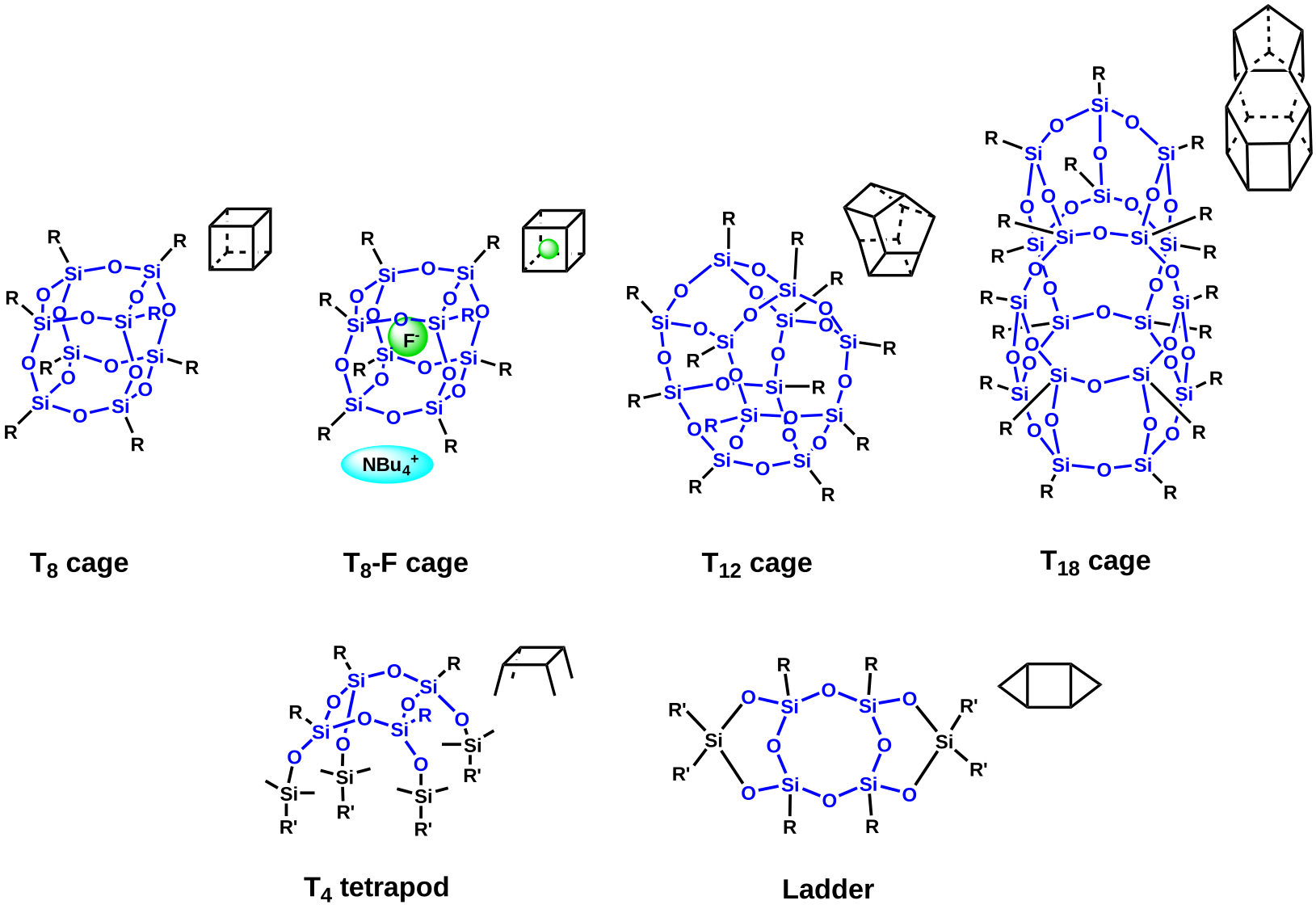
Exemples of silsesquioxanes oligomers
My research encompasses the following current working axes:
1. Oligomeric silsesquioxanes including Polyhedral Oligomeric SilSesquioxanes (POSS) and T4 derivatives
POSS molecules have gained significant attention, particularly for polymer applications, leading to the diversification and industrial production of T8 cages. However, larger cages and other oligomers remain underexplored.
Methodology of synthesis, structure understanding: Fundamental research on the synthesis conditions of larger cages and other oligomers is essential for unlocking new applications. This includes understanding possible structures and their characterization (e.g., ²⁹Si NMR). The identification of the obtained isomers is a major challenge, as the silicon cycle configuration can drastically influence the properties of the oligomers.
Image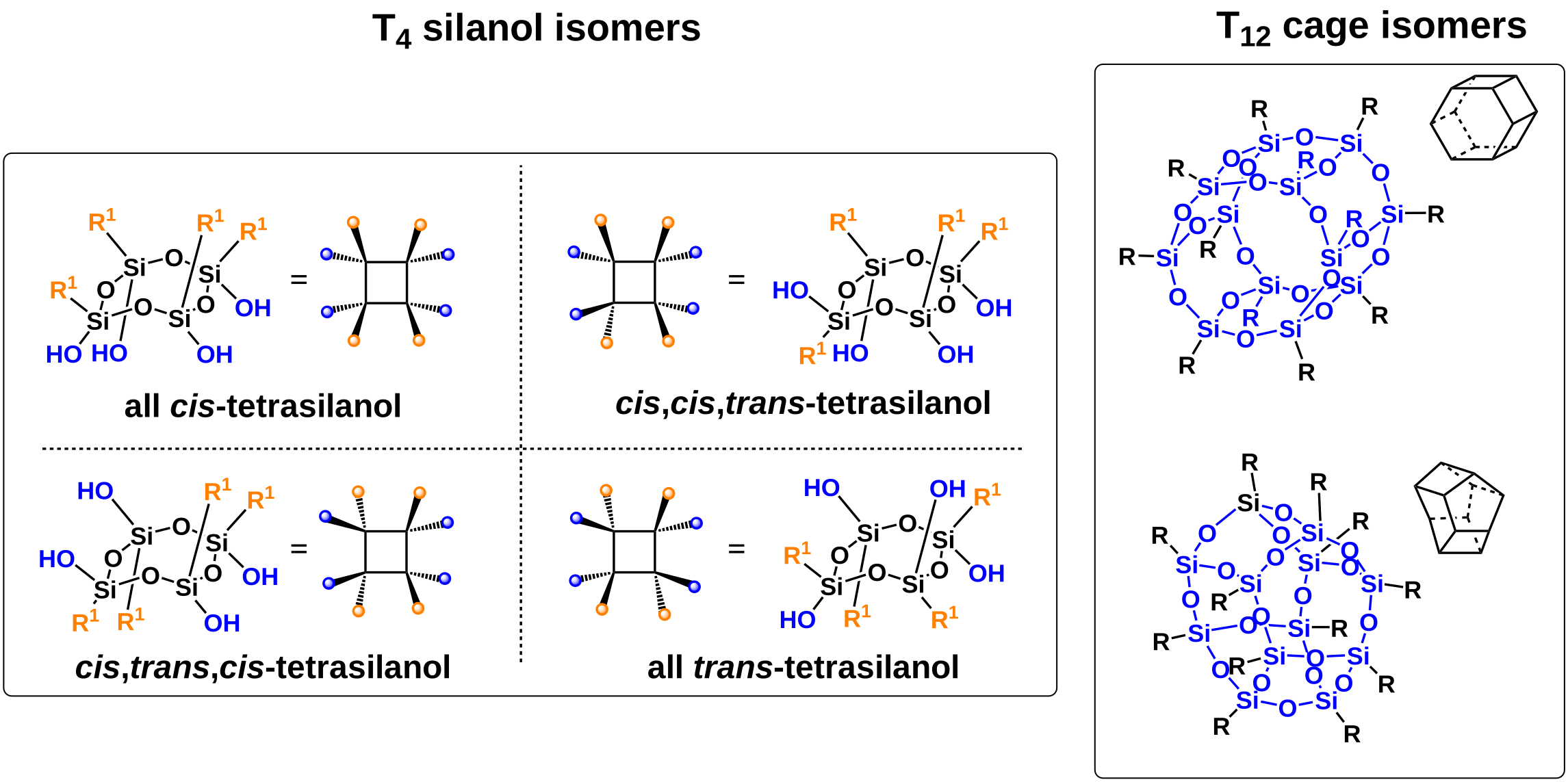
Study of the gas sorption properties of POSS for energy application: Few investigations exist on the gas sorption properties of POSS for energy-related uses. POSS-based materials offer advantages such as thermal stability and compositional simplicity (silicon, oxygen, and carbon). This project is funded by the French National Research Agency (ANR) through the POSS-CO₂FEE project.
2. Surface modification strategies of chalcogenide and silica substrates
Building on the work of Prof. Luc Vellutini, we explore organic functionalization strategies for inorganic surfaces, with a focus on sensing applications:
Functionalization strategies of chalcogenide glasses: We study the surface reactivity of these glasses, based on pioneer work on functionalization via hydroxyl and sulfhydryl surface groups.
Tridimensional functionalization of surface for biodetection: Leveraging the optical properties of chalcogenide glasses, we aim to develop infrared sensors with oligomeric silsesquioxanes to create 3D-structured sensor surfaces. This approach is expected to significantly enhance sensitivity, with a long-term goal of detecting disease biomarkers at low concentrations for early diagnosis.
3. Design and preparation of tailor made organosilanes for the synthesis of advanced functional materials
The sol-gel process is a versatile method for producing materials at low temperatures while incorporating organic groups into the network. My work includes designing functional silanes, surface modification and the creation of functional networks. Potential application ranges from drug delivery to coatings.
Grant/Funding
2026-2030: ANR POSS-CO2FEE, scientific coordinator (PI: Philippe Trens, ICGM Montpellier, France)
“Cage Siloxane Porous Liquids for the Selective Capture of hydrogen and carbon dioxide”2025: Young scientist starting grant from the Materials and Light Sciences Department of Bordeaux University (France)
“Three-dimensional functionalization of surfaces for biosensing”2023-2024: Alexander von Humboldt fellowship (University of Saarland, Germany)
“Thermoreversible bond formation as a motif for alkoxysilane precursors: applications in drug delivery, self-healing and optoelectronics materials”
Other activities
2025–2026
Board Member, International Sol-Gel Society (ISGS): Contributing to strategic decision-making for the society.
Elected Representative, Early Career Researchers Network (ISGS – ECR Network): Leading the establishment of the ECR branch (founded in February 2025) to promote young researchers within the sol-gel community and beyond. Key initiatives include fostering collaboration between early-career researchers and industry partners; developing scholarship programs and mentoring opportunities.