


About
University Professor — Surface modification and biofunctionalization
Institut des Sciences Moléculaires (ISM) — UMR 5255 CNRS / Université de Bordeaux / Bordeaux INP

Since 2022: Full Professor at the University of Bordeaux
2005-2022: Associate Professor at ISM UMR 5255 CNRS, University of Bordeaux.
July 03-August 05: Postdoctoral researcher (20 months) at the Institut Matériaux Jean Rouxel de Nantes, UMR 6502, Laboratoire de Physique des Matériaux et Nanostructure.
Research project: Synthesis and characterization of nanocomposites obtained by embedding conjugated polymers in porous silicon and silica.1999-2002: Ph.D., University of Montpellier II, Laboratoire de Chimie Organométallique, directed by Prof. J. Moreau and M. Wong Chi Man.
Research project: Synthesis and characterization of self-organized hybrid silica materials.
Research interest
During his thesis, L. Vellutini designed new organosilyl building blocks to achieve successfully the formation of chiral (left- and right-handed helices) hybrid silica as well as lamellar hybrid silicas. In this work, he showed that it was possible to transfer the chirality and self-assembled structures of the building-block precursors to the resulting materials using the sol-gel process.
After his thesis, Luc Vellutini was a postdoctoral fellow in the Institut des Matériaux Jean Rouxel de Nantes between 2003 and 2005. He worked in the field of porous silicon nanocomposites filled with optically active polymers. He has successfully explored the use of intermolecular H-bond interactions between monomers to control the organization of polymer chains after polymerization.
L. Vellutini is presently a full Professor at ISM. He is working on the design and development of new sensing platforms for applications in analysis and biological diagnosis. Progress in this field depends on controlling surface properties through functionalization and biofunctionalization. Within this context, he grafts new functionalized coupling agents (linear or dendritic) to covalently immobilize biomolecules (antibodies, proteins, bacteria…) onto solid substrates (glass and silicon) using Self-Assembled Monolayers (SAMs).
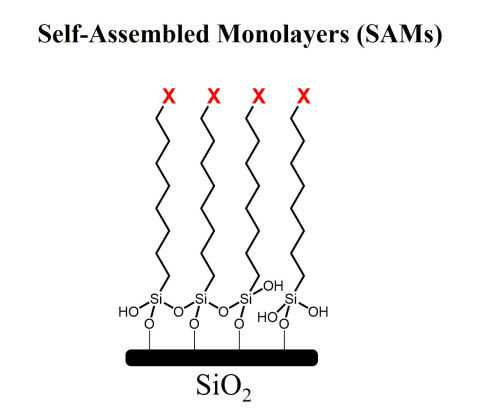
Bioactive SAMs: Organosilanes have been developed to immobilize biological species (antibodies, proteins, peptides, aptamers, etc.) and nanomaterials (gold nanoparticles) for use in biosensor applications or to develop substrates for stem cell growth.
Photoactive SAMs: Monolayers have been developed to provide end groups that respond or react to UV-Vis irradiation, such as photolabile ester groups or azobenzene derivatives.
In the field of SAMs, he has developed methods for grafting organosilanes on flat substrate using the classic immersion solution method and spin-coating. The latter process is fast, simple, easy to handle, conducted under ambient conditions, and uses less organic solvent.
Recently, our research group developed three different approaches for grafting heterobifunctional derivatives onto chalcogenide substrates (GeSbS). One of these approaches involves using silane chemistry to functionalize the hydroxyl groups on the ChG, whilst the other two are novel strategies that exploit the reactivity of maleimide and cyclooctyne derivatives to modify the SH groups on the surface of the inorganic glass matrix. Our results showed that the biofunctionalization of ChG was achieved by all three methods. Furthermore, this functionalization process can be readily adapted to substrates with different geometries and to the grafting of different molecules onto the surface, paving the way for the future development of infrared optical detection systems exhibiting surface bioselectivity.
Grant/Funding
AAP ANR générique 2023, PRC, Patterning of Surface Electrical Potential and Chemical Reactivity on Chalcogenide Glass for IR application (SURF-GLASS-IR).
- AAP ANR générique 2024, PRCE, Multi-functional optical fibers based infrared spectroscopic bio sensing (FIBERSPEC)
Institutionnal responsabilities
- Since 2011, Head of Quality, Safety and Environment for the Master’s degree in Chemistry (QSE)
- Since 2016, Head of the University Diploma (DU) in QSE