


DYe-Sensitized p-type Photocathodes with Optimized transport and panchromatic absorption properties for solar Water-splitting – DYSPOW (CE50)
Coordination: Thierry Toupance (ISM/C2M)
Duration: 2026-2029
In the context of solar fuel development, dye-sensitized photoelectrochemical cells that directly convert solar energy into chemical energy have attracted growing global interest. However, the nickel oxide (NiO)-based photocathodes typically used have several drawbacks, such as low charge carrier mobility, limited chemisorption capacity for the dye and/or reduction catalyst, and poor stability. Moreover, the kinetics of electron transfer at the dye/electrolyte interface, the spatial heterogeneity of catalytic activity, and the influence of dye-semiconductor interactions on charge recombination pathways and overall photocathode efficiency are not yet fully elucidated. It is therefore necessary to develop new photocathodes based on p-type semiconductors that outperform NiO and on dyes that ensure more efficient collection of solar energy, along with the use of advanced analytical approaches capable of probing local electrochemical phenomena with high spatial resolution.
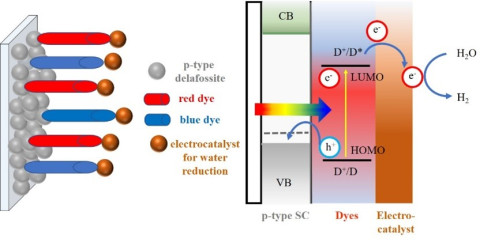
To draw new prospects in this domain, DYSPOW develops efficient and stable dye-sensitized p-type photocathodes centered on (i) mesoporous p-type metal oxide photocathodes fabricated from delafossite CuIMIIIO2 nanoparticles and (ii) co-sensitization using various dyes showing complementary solar light absorption properties from the Ultra-Violet (UV) to the Near-InfraRed (NIR) range. The main objectives of the DYSPOW project are:
To develop straightforward synthetic routes towards delafossite nanoparticles and process optimized porous delafossite electrodes showing enhanced both dye and catalyst loadings ;
To design, synthesize and characterize original organic dyes endowed with various anchoring groups and absorbing in the red and the near-infrared regions;
To evaluate and optimize the photoelectrochemical properties of the photocathodes resulting from the association of both delafossite nanoparticulate layer and original dyes and determine their ability to reduce H2O;
To investigate fundamental processes occurring at dye-sensitized p-type photocathode surfaces using advanced analytical techniques such as Scanning Electrochemical Microscopy (SECM). Specifically, we aim to elucidate interfacial electron transfer kinetics, local catalytic activity, and dye-semiconductor interactions, thereby identifying key parameters influencing photocathode efficiency and stability.
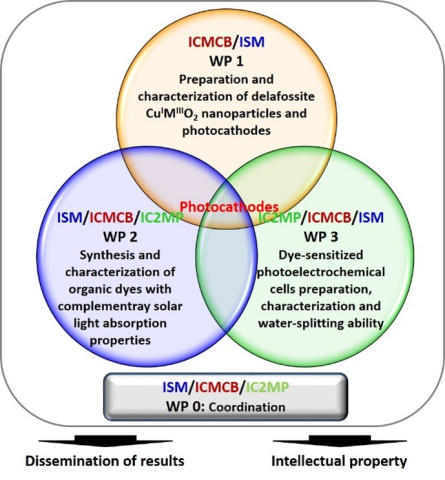
To reach the goals of DYSPOW a bottom-up approach will be developed by three complementary research teams (ISM/C2M Univ. Bordeaux, ICMCB Univ. Bordeaux, IC2MP Univ. Poitiers) according to a scientific program based on the three following work packages (WPs).
WP1 includes the preparation and characterization of p-type delafossite nanoparticles and photocathodes. Various solvothermal/hydrothermal routes will be investigated using different activation modes (conventional heating, microwave-assisted).
WP2 concerns the synthesis and characterization of new organic dyes that exhibit complementary absorption of sunlight and are capable of binding to water-reduction catalysts. The main goals are: 1) the development of “red” organic photosensitizers equipped with coordination ligands and new anchoring groups; 2) the design and synthesis of “green” and “blue” organic dyes based on aza-BODIPY or triphenodithiazine cores; 3) the preparation of dye-reduction catalyst dyads ; 4) Rationalization of the structure-electronic property relationships for these new families of dyes and of the corresponding dyads.
WP3 focuses on the processing of dye-sensitized photoelectrochemical cells along with their characterization and their water-splitting ability. Specific efforts will be devoted to the determination of the water splitting mechanism using these photocathodes by advanced tools such as electrochemical microscopy.
Consortium:
ISM – C2M : Thierry TOUPANCE, Yohann NICOLAS, Guillaume CLERMONT
ICMCB (Bordeaux):
IC2MP Univ. (Poitiers):